

Squealing or Grinding Brakes: Why the European Quote Is Higher Than You Expected
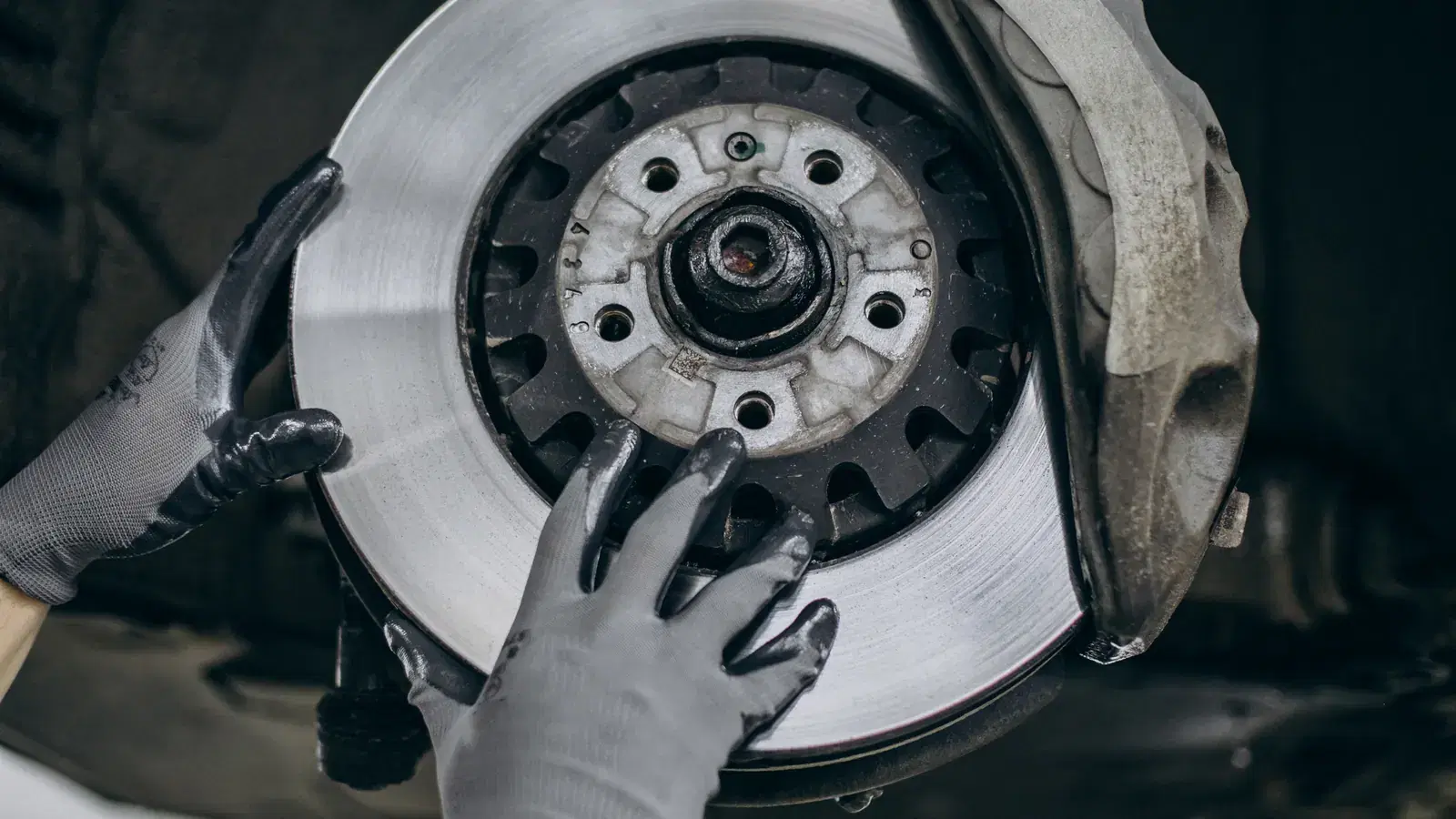
Short answer
A European brake quote is usually higher because a correct job covers more than pads. It includes new electronic wear sensors, a scan tool to open and recalibrate an electronic park brake, a service indicator reset, and discs measured against their minimum thickness. A much cheaper quote usually leaves some of that out.
At a glance
- A squeal on light braking is often the wear indicator. Grinding means the pads are gone and every stop is damaging the discs.
- Electronic pad wear sensors are replaced with the pads. The parts suppliers say they must not be reused.
- Rear pads under an electronic park brake need a diagnostic tool to open the system and to calibrate it afterwards.
- Discs are measured against the minimum thickness marked on them. Pads should only go onto discs above that limit.
- Brake fluid absorbs moisture and is commonly specified for replacement every 24 months, whatever the kilometres.
You get a squeal on light braking, or a warning on the dash, and you ring around for a price.
The quick fit place quotes you a couple of hundred. The European specialist quotes you considerably more. Same car, same brakes, and the difference looks like a badge tax.
It usually is not. There are four things in a modern European brake job that a cheap quote tends to leave out, and they are most of the difference.
What is the noise telling you?
A squeal on light braking is often the wear indicator. Grinding means the pads are worn through. A shudder in the pedal points at the discs, and a dash warning with no noise is the electronic wear sensor. A squeal that clears after a few stops on a damp morning is usually just surface rust.
| What you notice | What it usually means | What to do |
|---|---|---|
| High pitched squeal on light braking | A metal wear indicator on the pad touching the disc | Book it in soon |
| Squeal in the morning or after rain that clears after a few stops | Surface rust on the discs wiping off | Nothing, if it clears |
| Grinding or grating, metal on metal | Pad friction material gone, backing plate on the disc | Stop driving on it |
| Shudder or pulsing through the pedal | Disc run-out, uneven disc thickness or heat distortion | Have the discs checked |
| Dash warning with no noise | The electronic wear sensor has reached the limit | Book it in soon |
The squeal is a designed warning. HELLA describes the acoustic type as a plate on the pad that reaches the disc at the wear limit and "generates an unpleasant screeching sound." It means the pads are due, not that something has failed.
The grind is the one to take seriously. The friction material is gone, and every stop is now cutting into a disc that may have been fine last month. A pad job has just become a pad and disc job.
The shudder is not usually the pads at all. Ferodo lists three causes of brake judder: a disc pulled out of alignment when fitted, heat distorting the disc, and variation in the disc's thickness. All three point at discs rather than a pad swap.
The silent dash warning is the electronic wear sensor, which brings us to the first reason the quote is what it is.
Why does the wear sensor need replacing with the pads?
Because it is designed to be used up. The sensor sits in the pad, and once the pad wears far enough the disc reaches it and trips the warning. HELLA's instruction to workshops is direct: "The electrical wear contacts must always be replaced when replacing the brake pads!"
Many European cars use one of these instead of relying on a squealer tab. Depending on the design, the pad wearing down either breaks a circuit in the sensor or completes one. Either way, that is what turns the dash light on.
The heat and the years do the wiring and the retaining clip no favours either. Refitting an old sensor is how you end up with a warning light that returns a week after you paid for new brakes.
It is not an expensive part. But it is a part, and it is one of the first things a bargain quote leaves out.
Why does an electronic park brake need a scan tool?
Because the park brake motor sits behind the caliper piston, and it has to be moved out of the way electronically before the pads can come out. ZF's instruction for its TRW system is that "a diagnostic service tool must be used" to change the rear pads correctly and safely.
This is the big one, and it is the reason a rear brake job on a modern European car is a workshop job rather than a driveway job.
On an older car with a cable handbrake, you wind the caliper piston back with a hand tool and fit the pads.
An electronic park brake puts a motor on the back of the caliper, driving a spindle inside the piston. The scan tool puts the system into its pad change mode, which retracts that mechanism. The pads go in, and then the system is closed up and calibrated with the same tool.
Winding the piston back the old way is not an option. TRW's guidance is that the piston in an EPB caliper "must not be rotated back to the start position", because doing so "leads to damage to the pressure nut and/or spindle!" The calibration afterwards is not optional either. TRW says the system "must be calibrated using the diagnostic device."
That is a scan tool, the correct software for your marque, and the time to use it. You will find electronic park brakes across current VW, Audi, Mercedes-Benz, BMW and Volvo models.
Why does the service indicator need resetting?
Because the car keeps its own record of pad wear, and it does not know you fitted new pads until it is told. Skip the reset and the warning can stay on or come back, and the car keeps working from the old numbers.
On cars with a TRW electric park brake, ZF notes that calibrating the system with the diagnostic tool after the job is what resets "the internal pad wear indication of the system."
Other cars keep a pad wear or service counter in their service indicator. Either way, it is a step done with a diagnostic tool, and it takes time a cheap quote does not allow for.
Do European pads always need new discs?
Not always, but often. Brembo's general rule is that "brake discs should be replaced during every other brake pad replacement." Whether yours are due comes down to one measurement: disc thickness against the minimum the manufacturer marks on the disc.
That minimum is stamped on the disc, marked MIN TH. Brembo explains why it matters: "Reduced thickness reduces the heat dissipation capacity of the disc and its mechanical strength." A thin disc runs hotter and is more prone to cracking and distortion.
HELLA's fitting rule is plain: "Only install new brake pads if the minimum thickness of the brake discs has not been undercut."
Measuring the discs takes a few minutes, and it is the difference between an honest quote and a cheap one that comes back. Discs are replaced in pairs across an axle, and a disc that is scored, cracked or causing a shudder is replaced regardless of its thickness.
If your discs measure fine, we will tell you and fit pads only.
Why test the brake fluid on a brake job?
Because brake fluid absorbs moisture as it ages, and water in the fluid can boil under heavy braking. It is the one part of the brakes that wears out without making any noise. The Institute of the Motor Industry notes that "Manufacturer's data generally gives a 24-month lifespan for common use brake fluid."
Common brake fluid is glycol-based and, in the IMI's words, "hygroscopic (it absorbs moisture from the air)". That is why the interval runs on time, not kilometres.
Under normal driving you would never notice. Come down a long descent riding the brakes, or brake hard a few times in a row, and the heat reaches the fluid. The IMI puts it plainly: "the water can vaporize in the system creating gaseous pockets." Vapour compresses where fluid does not, and the pedal goes soft or long at the moment you need it.
The water content can be tested in the workshop. Because the car feels no different until the fluid is well past it, the change is easy to put off.
What should a fair brake quote include?
A fair quote covers pads and wear sensors, measured discs, the electronic park brake handled with a scan tool, the service indicator reset, and the brake fluid tested. When you compare prices, check whether the number covers each of these:
- Pads, and the correct compound for your car
- New wear sensors where the car has them
- Discs measured, and replaced if they are at or near minimum
- Electronic park brake opened and calibrated with a scan tool
- Service indicator reset
- Brake fluid tested, and changed if it is due or wet
- Hardware checked, and slide pins cleaned and lubricated
A quote that is much cheaper than the rest is usually cheaper because some of that list is missing. Which is fine, as long as you know which parts.
We diagnose it. We fix it.
Brake and suspension work starts from $390. We measure the discs and test the fluid before quoting, and you get photographs and a written quote before any work is authorised.
If your brakes are grinding, do not wait. That is the one on this list that gets more expensive every day you drive it.
Book a brake inspection, or see which European marques we work on.
Sources
- Brake pad wear indicatorHELLA Tech World
- Electric park brake replacementKnow Your Parts (TRW)
- How to change brake pads with EPBZF Aftermarket
- How to change the caliper when a car is fitted with TRW electric park brakeZF Aftermarket
- Minimum brake disc thicknessBrembo
- Testing the minimum thickness of a brake discHELLA Tech World
- Brake judderFerodo
- Boiling point for brake fluidInstitute of the Motor Industry
Common questions
- Is it safe to keep driving with the brake pad warning light on?
- The light means the pads have reached their wear limit, so book the car in soon rather than waiting for the next service. If the warning comes with grinding, a pull to one side or a changed pedal, stop driving and have it checked first.
- Why did the brake warning light come back after new pads were fitted?
- The usual causes are an old wear sensor refitted with the new pads, or a pad wear counter or park brake calibration that was not reset with a diagnostic tool. A fault in the sensor wiring or connector can do it too. It needs reading with a scan tool, not guessing.
- Do discs have to be replaced on both sides?
- Yes. Brembo's guidance is that discs are replaced on both sides of an axle even if only one of the pair is below its minimum thickness, so the car brakes evenly. Pads are also replaced as an axle set.
- How often should brake fluid be changed?
- Follow the schedule for your car. Manufacturers commonly specify brake fluid replacement every 24 months, by time rather than kilometres, because the fluid absorbs moisture as it ages. A test tells you where your fluid sits now.
Related reading
The Code Reader Said P0300. That Was the Symptom, Not the Fault.
A fault code is not a diagnosis, it is a report that a value went out of range. What a cheap scanner cannot see, and why people replace parts twice.
The Dealer Said the Fluid Is Lifetime. Whose Lifetime?
Lifetime fill is a real term with a specific meaning, and it is not the one most owners take from it. What a jolting cold shift is actually telling you.
It Drives Fine and the Service Book Is Full. Should I Buy It?
A full service book is a good sign. It is not the same thing as a good car, and on a European car the gap between the two can be an expensive one.
Want it looked at properly?
Factory-level diagnostics for eighteen European marques, and a written quote with photographs before anything is authorised.