
The Code Reader Said P0300. That Was the Symptom, Not the Fault.
Short answer
P0300 means the engine control unit has detected misfires it cannot pin to one cylinder, or misfires across several. It names the symptom, not the cause. Worn plugs, failing coils, injectors, fuel delivery, vacuum leaks and low compression can all set it, so the fault has to be found before parts are replaced.
At a glance
- P0300 reports random or multiple cylinder misfires. It does not say which part has failed.
- Plugs, coils, injectors, fuel delivery, vacuum leaks and low compression can all set the same code.
- A generic reader covers emissions-related powertrain codes. Body and chassis modules need an enhanced or factory tool.
- A flashing check engine light signals a misfire that can damage the catalytic converter. Slow down and get it seen promptly.
- Do not clear the code before the car is diagnosed. Clearing it also erases the freeze frame data.
"I plugged my scanner in and it said misfire, so I changed the plugs. It is still doing it."
That is the most common version of this conversation, and the customer has usually already spent money before they ring.
The scanner was not lying. It just was not telling them what they thought it was telling them.
What does P0300 actually mean?
It means the engine control unit has detected misfires that it cannot pin to one cylinder, or misfires spread across more than one. It is a report that something went outside an expected range. It is not a diagnosis, and it does not name a failed part.
Where the misfire is clearly in one cylinder, the car will usually set a cylinder-specific code instead: P0301 for cylinder 1, P0302 for cylinder 2, and so on. P0300 is what you get when it is random or spread around. MOTOR magazine, writing for technicians, calls the bare P0300 code "almost useless information, other than giving you freeze frame parameters."
Worn plugs can cause it. So can failing coils, a fuel delivery problem, a faulty injector, a vacuum leak, low compression, and mechanical faults that have nothing to do with ignition at all.
The reader gives you the number. Working out which of those things produced it is the actual job, and a cheap scanner cannot do it, because it cannot see the data that separates them.
The same is true right across the dash. A gearbox fault message means the transmission control module is unhappy. It does not tell you whether the selector failed, the wiring chafed, the module died, or the battery went flat enough overnight to upset several modules at once.
What can a cheap code reader not see?
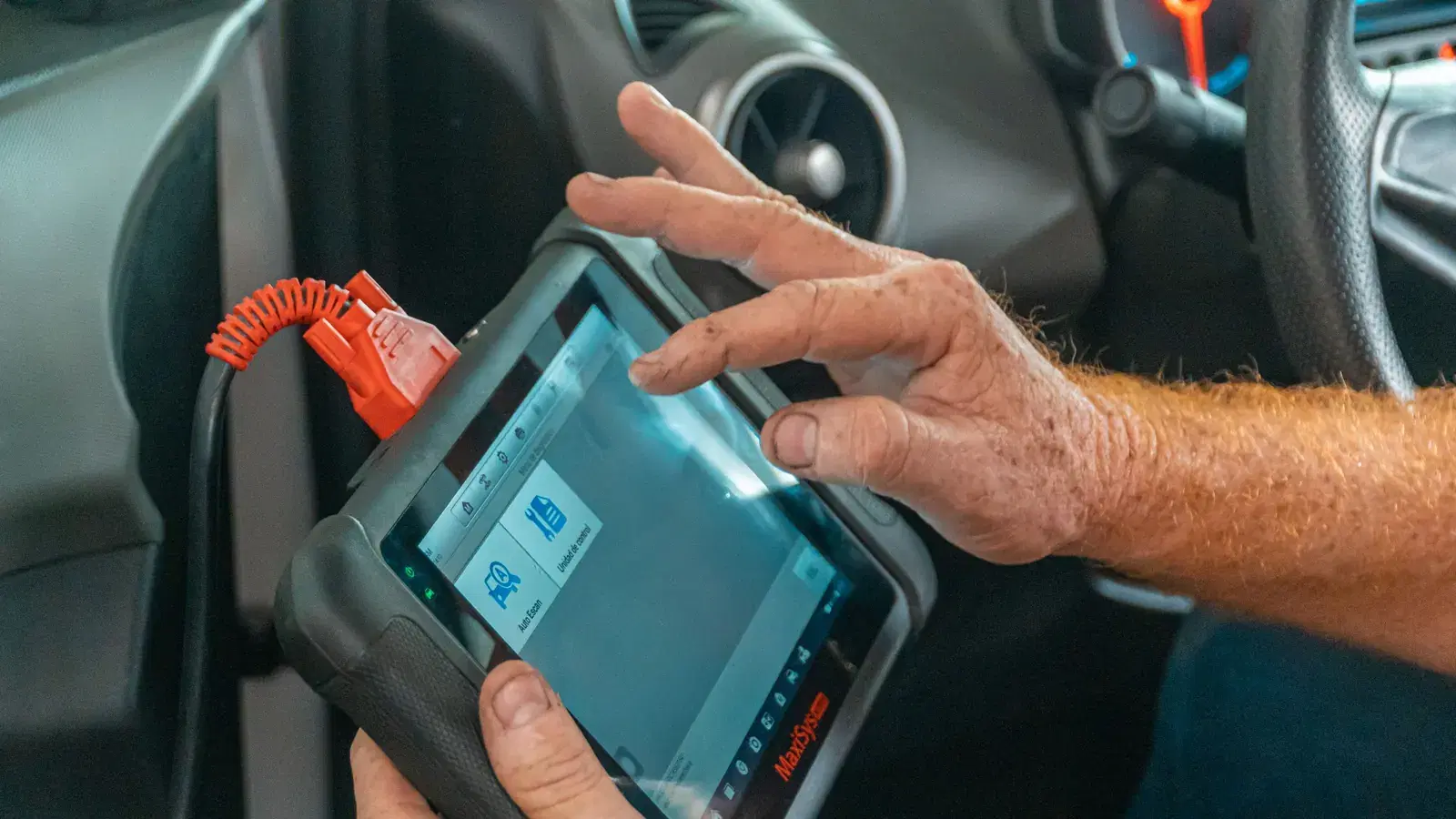
Most of what separates one cause from another. A generic reader asks the car for standardised, emissions-related powertrain codes. It does not reach the other modules, and it shows little of the live and test data behind a code. That data is what you are actually paying a workshop to read.
Bosch's diagnostics product manager put it plainly: generic tools "only focus on emissions-related powertrain systems with few bi-directional controls and do not cover body and chassis systems."
Live data. What the sensors are reporting right now, while the engine is running and while the fault is happening.
Freeze frame. A snapshot of what the engine was doing at about the moment the code set. Cold or hot, idling or under load. That tells you a great deal about cause.
Misfire data per cylinder. Which cylinder, and how often. A basic reader shows P0300 and stops. Per-cylinder misfire results, where the car reports them, show whether it is one cylinder badly or several slightly, and those lead in completely different directions.
Manufacturer-specific codes. Many fault codes on a European car are the manufacturer's own, not the generic set. Snap-on's documentation notes that the generic stored-code request "does not include enhanced DTCs."
This is the reason factory platforms exist. We run ISTA for BMW, XENTRY for Mercedes-Benz, ODIS for VW, Audi, Skoda and Seat, PIWIS for Porsche and VIDA for Volvo. The same software the dealership uses, reading the same data.
Every other module. Body, transmission, chassis, comfort. A fault stored somewhere else very often explains the symptom you came in with.
Why test the battery before blaming a module?
Because low or interrupted voltage can produce faults that look like failed parts. Before anyone replaces a module on a modern European car, the battery and charging system get tested. It is a quick test, and it is the first one worth doing.
These vehicles carry a lot of electronics, and they do not like an unstable supply. Varta, the battery maker, notes that "electronic systems in newer vehicles can trigger error messages or lose data when the power supply is interrupted." A tired battery can leave faults stored across several modules at once, and a module replaced on the strength of those faults may not have been the problem.
After that: power, earth and network communication, to confirm the modules are actually talking to each other before deciding one of them has failed.
What can the old spark plugs tell you?
Quite a lot about what has been happening in that cylinder. NGK puts it simply: "Appearance of a used spark plug tells a lot about the operating conditions of the engine and the plug." That is why we look at the old plugs before fitting new ones.
Electrode wear shows how long it has been in: as the gap erodes, the plug needs more voltage to fire. Heavy black deposits can point at a rich mixture, though NGK also lists a vacuum leak, low compression and retarded timing among the causes. Wet deposits can mean oil getting past rings or valve gear, a head gasket fault, or an extremely rich mixture. A cracked insulator or melted electrode points at overheating, which is a different conversation entirely.
If one plug looks obviously different from the others, that is where to start looking. Replacing them all and hoping is not diagnosis, it is shopping.
Is a flashing check engine light worse than a steady one?
Yes. A steady light means a fault has been stored and the car needs service. A flashing light means a misfire is happening that is severe enough to damage the catalytic converter. The California Air Resources Board says a blinking light "indicates that a malfunction is occurring that could be damaging your catalytic converter."
| Steady light | Flashing light | |
|---|---|---|
| What it means | A fault has been detected and stored | A misfire severe enough to damage the catalytic converter is happening now |
| Is it urgent? | Book it in soon | Reduce speed and get it seen as soon as possible |
| What to do | Note what the car was doing and leave the code alone | Avoid heavy load and drive it as little as possible |
The reason is fuel. Walker, the exhaust maker, explains that when the charge leaves the cylinder without firing, "it will travel through the exhaust pipe and burn in the converter." That heat can damage the converter from the inside.
The EPA's advice for a flashing light is that the driver "should reduce speed and seek service as soon as possible." Severe misfire over even a short period can seriously damage the catalytic converter, which the EPA notes "is typically the most expensive to replace."
Will an intermittent fault fix itself?
Rarely. An intermittent electrical fault is usually a connection, a component or a wire that is on its way out, and it tends to get more frequent, not less.
Plenty of breakdowns start as something that happened once or twice and then went away for a while. If something has played up twice, book it while the car is still moving under its own power.
How can you help the diagnosis?
Tell us what the car was doing when the light came on, and leave the code alone. Cold start, in traffic, after fuel, in the wet. That detail narrows the diagnosis faster than anything on the scanner.
Do not clear the code before you bring it in. Snap-on's documentation for technicians notes that clearing codes "erases all stored data, including any enhanced codes and freeze frame information." The freeze frame is often the most useful thing we had.
What does a proper diagnosis cost?
Our diagnostics start at $145. That covers a full system scan on the factory platform for your marque, the live data and freeze frame that goes with it, and a written report of what we found.
You get photographs of the fault and a written quote before any repair is authorised. Nothing gets replaced on a guess, and nothing gets replaced without you seeing it first.
Compared against the cost of buying parts that turn out not to be the problem, it is usually the cheapest money spent on the car.
We diagnose it. We fix it.
If you have a light on, or a light that came back after someone already replaced something, we will read it properly before anyone buys another part.
We are in Dandenong, five minutes from the highway, with off street parking and early drop off. Book it in and tell us what the car was doing when the light appeared.
Sources
- Frequently Asked Questions About On-Board Diagnostics (EPA 420-F-97-003)US Environmental Protection Agency
- On-Board Diagnostic II (OBD II) Systems Fact SheetCalifornia Air Resources Board
- Shots in the Dark: Engine Misfire DiagnosisMOTOR Magazine
- Tool Q&A: Need OE scan tool capabilities?Vehicle Service Pros
- OBDII Service ModesSnap-on
- How do I read a spark plug?NGK Spark Plugs
- Spark plug analysisNGK Spark Plugs Australia
- Catalytic Converter FAQWalker Exhaust
- Varta explores potential increase in battery failuresProfessional Motor Mechanic
Common questions
- What is the difference between P0300 and P0301?
- The codes from P0301 upwards name a single cylinder, so P0301 is cylinder 1, P0302 is cylinder 2, and so on. P0300 is set when the misfire is random or spread across more than one cylinder. Even a cylinder-specific code still needs confirming, because it points at a cylinder, not a part.
- Can I keep driving with a P0300 code?
- If the light is steady and the car drives normally, drive gently and book it in soon. If the light is flashing, the misfire is severe enough to damage the catalytic converter, so reduce speed, avoid heavy load and get the car seen as soon as possible.
- Will clearing the code fix the misfire?
- No. Clearing the code only turns the light off. If the fault is still there, the code comes back once the engine detects the misfire again. Clearing it also erases the freeze frame, the record of what the engine was doing when the fault set.
- If the catalytic converter is damaged, is replacing it enough?
- Not on its own. A converter damaged by misfire was a victim, not the cause. Walker, the exhaust maker, advises finding and fixing the root cause first, otherwise the new converter faces the same unburned fuel and the fault can return.
Related reading
The Dealer Said the Fluid Is Lifetime. Whose Lifetime?
Lifetime fill is a real term with a specific meaning, and it is not the one most owners take from it. What a jolting cold shift is actually telling you.
White Smoke From the Exhaust: When It Is Nothing and When to Stop Driving
White exhaust smoke on a cold morning is condensation. Thick white smoke once the engine is warm usually means coolant, and that is a stop driving fault.
It Drives Fine and the Service Book Is Full. Should I Buy It?
A full service book is a good sign. It is not the same thing as a good car, and on a European car the gap between the two can be an expensive one.
Want it looked at properly?
Factory-level diagnostics for eighteen European marques, and a written quote with photographs before anything is authorised.