

Timing Belt: The One Service Where Waiting Costs You the Engine
Short answer
Replace a timing belt at the interval your car's manufacturer sets. Where the schedule gives both kilometres and years, whichever comes first applies, because belts age with time as well as use. A belt can fail without warning, and on an interference engine that lets the pistons strike the valves.
At a glance
- The replacement interval comes from the vehicle manufacturer. Where it gives kilometres and years, replace at whichever comes first.
- On an interference engine, a broken belt can let the pistons strike the valves and cause major internal damage.
- A belt can fail without notice. A ticking noise or misfire sometimes comes first, but you cannot rely on it.
- The tensioner and idler pulleys are replaced with the belt, and so is the water pump where the belt drives it.
- Wet belts, such as the one in the Peugeot and Citroën 1.2 PureTech, run in oil and depend on correct oil changed on time.
Most maintenance you can put off for a while. You will get a noise, a light, a soft pedal, some warning that the car is unhappy, and you deal with it then.
A timing belt does not work like that. It can give you almost nothing, and then everything at once.
That is the whole reason it gets replaced on an interval rather than on a symptom.
What does a timing belt do?
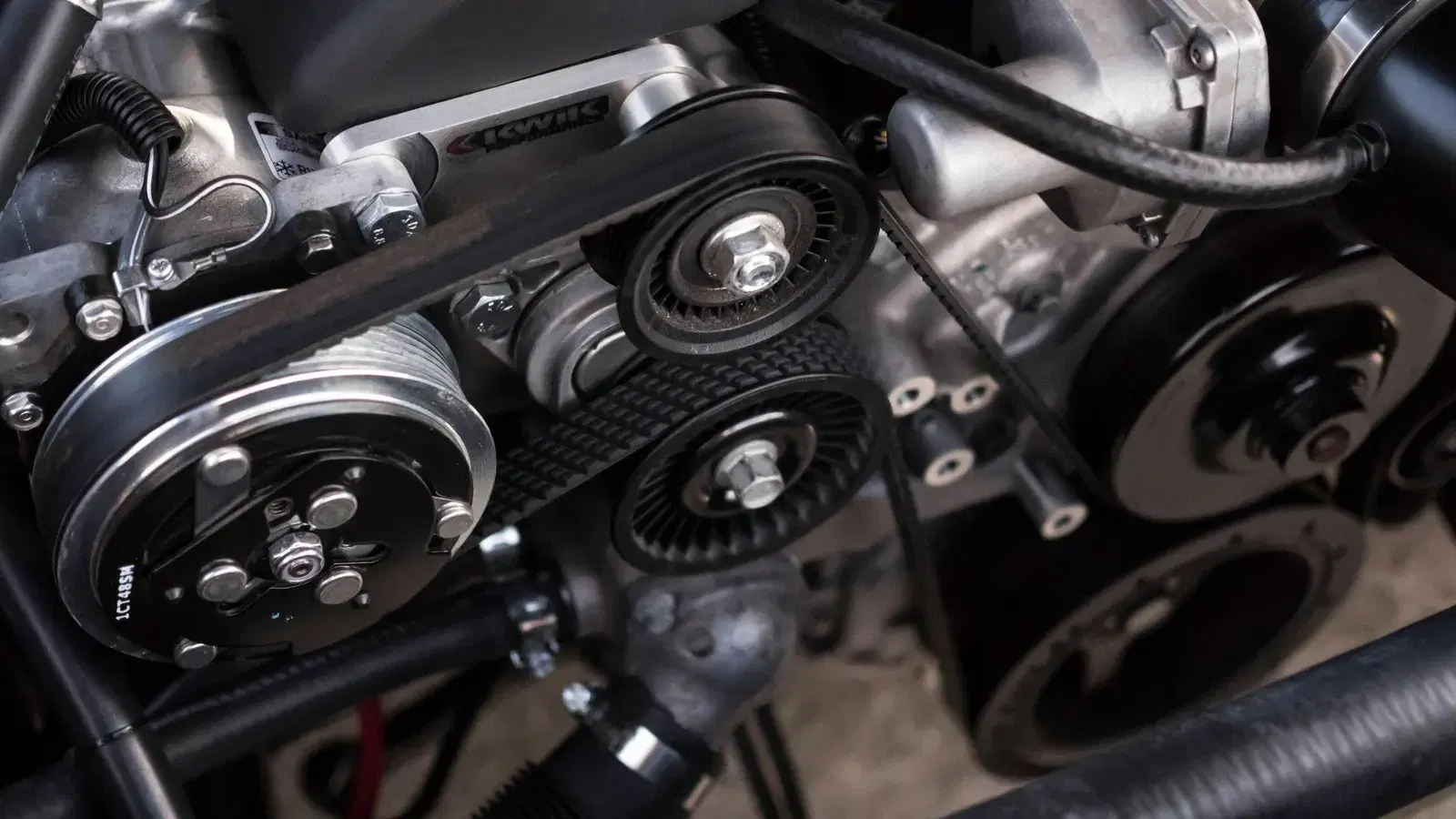
It keeps the crankshaft and the camshafts turning in step, so the valves open and close at the right moment relative to the pistons. As Gates puts it, the belt "ensures that the engines valves open and close at proper times."
On many engines it also drives the water pump, which becomes important later.
What happens if a timing belt breaks?
The engine stops. What happens next depends on whether your engine is an interference design.
On a non-interference engine, the valves and pistons cannot occupy the same space. The engine stops, you get towed, a new belt goes on, and you carry on. Annoying and expensive, but survivable.
On an interference engine, they can. The pistons keep travelling while the valves have stopped where they were. The valves get struck and bent, and the pistons and the cylinder head can be damaged too. Cars.com describes it as "major internal engine damage that can be expensive to repair", and on an older car that repair can outweigh what the car is worth.
You cannot tell which one you have from the badge. It is specific to the engine, and it is worth finding out before anything else.
How often should a timing belt be replaced?
At the interval your car's manufacturer sets for that engine. Where it gives both kilometres and years, replace the belt at whichever comes first. Belt maker Continental is plain about it: the intervals "are always specified by the vehicle manufacturer and must be complied with."
The years part is where people get caught. Belt drive components, in Continental's words, "are subject to aging and wear", and a car that does short, gentle trips can reach the years limit well before the kilometre figure.
Check the service history for the date of the last belt, not just the odometer reading.
Timing belt, wet belt or chain: what is the difference?
All three do the same job. They differ in what they are made of, where they run, and what shortens their life.
| Timing belt | Wet belt | Timing chain | |
|---|---|---|---|
| What it is | Toothed belt running dry, behind covers | Belt that runs inside the engine, in the oil | Metal chain lubricated by engine oil |
| Replacement | On the manufacturer's interval | On the manufacturer's interval, which was shortened on the 1.2 PureTech | Often no scheduled interval; many last the life of the car |
| How it wears | Ages with time and use; the tensioner and idlers wear with it | Can shed debris into the oil | Lengthens as its components wear, known as chain stretch |
| What helps it last | Replacing it on time as a kit, and keeping oil and coolant off it | Correct oil, changed on time | Correct oil, changed on time |
Wet belts: why oil changes matter more
Some newer engines run the belt inside the engine, lubricated by the oil. The Peugeot and Citroën 1.2 PureTech petrol engine is the best-known example, and Ford's 1.0 EcoBoost uses one too.
Two things matter about them.
The interval can be shorter than you expect. In the UK, the 1.2 PureTech's belt interval was cut from 112,500 miles or 10 years to 64,000 miles or 6 years, about 103,000 km. Intervals can differ by market, so check the schedule for your car.
And when a wet belt starts breaking down, the debris goes into the oil. The OESAA's guidance for the PureTech is that it collects on the oil pump strainer, and it recommends checking the vacuum pump oil passage, the variable valve timing solenoids and the turbo oil feed during the job. On the Ford 1.0, fragments have clogged the oil pump pickup and starved the engine of oil. So the belt can harm the engine before it ever snaps.
In Australia, Peugeot recalled 2,212 208, 308 and 2008 models from 2017 to 2020 (REC-005686) because "the timing belt may degrade due to aged engine oil", which could reduce braking performance.
Correct oil specification and on-time oil changes matter more on these engines than on almost anything else. If you drive one, find out where you sit on the interval.
Why replace the water pump and tensioner with the belt?
Because they wear alongside the belt, and they sit behind the same covers. A proper timing belt job is a kit, not a belt, and the belt makers themselves say so.
The tensioner and idler pulleys run on bearings that have done the same kilometres as the belt. Gates warns that "failure to replace the tensioner & idler bearing often leads to premature belt failure", and that a worn one leaves a loose belt that slips.
The water pump, where the belt drives it, sits behind the same covers. Continental's guidance is that on those engines "the pump should also be replaced when the timing belt is changed." Replacing it later means paying for the strip-down a second time.
Leaking seals matter because fluids must stay off the belt. Gates notes that oil and coolant "could cause serious engine problems if allowed to enter the timing belt drive system." A seal found leaking with the covers off is worth fixing while it is accessible.
Reaching the belt is most of the work. The parts behind the same covers are cheapest to replace while the engine is already apart.
What a correct job looks like
- Confirm the exact belt specification and interval for your engine and build date, not just the model
- Strip down to the timing belt covers
- Fit the full kit: belt, tensioner, idlers, and the water pump where the belt drives it
- Lock and set the timing with the correct tools for the engine
- Turn the crankshaft two full turns and re-check the timing with the locking tools or marks, following the manufacturer's procedure
- Refill and correctly bleed the cooling system if it was opened for the pump
- Road test and recheck
That two-turn check is not optional. Dayco's fitting guidance for the VW Group 2.0 TDI builds it in. If anything has moved during fitting, that is when you find out, on the bench instead of on the road.
When to do it
Before it is due, not after. You cannot count on a warning.
Book it before a long drive rather than after one. If you are heading up the Hume over Christmas on a belt that is at or near its interval, that is the trip where the age of the rubber stops being theoretical.
We diagnose it. We fix it.
Tell us the model, the build year and the kilometres and we will tell you whether your engine has a belt or a chain, whether it is an interference design, and where you sit against the interval.
You get a written quote before anything starts, and photographs of the old belt when it comes off.
Book a timing belt check, or read what timing belt replacement covers and which European marques we work on.
Sources
- Timing belt kitContinental
- Timing belt kit + water pumpContinental
- Timing 101Gates
- Gates outlines timing belt drive issuesProfessional Motor Mechanic
- Timing belt fitting guidelines from DaycoFactor Focus
- Timing belt vs. timing chain: what's the difference?Cars.com
- 1.2 PureTech belt in oil: the best practiceProfessional Motor Mechanic (OESAA)
- Peugeot 308, 208 and 2008 recalledCarExpert
- Ford EcoBoost timing belt probeCarscoops
- Timing chain replacementSnap-on
Common questions
- Can I tell if my timing belt is worn by looking at it?
- Not reliably. A dry timing belt sits behind covers, and a belt can fail without notice even when nothing seemed wrong. The dependable approach is to replace it at the manufacturer's interval rather than wait for it to look or sound worn.
- Does a timing belt make noise before it breaks?
- Sometimes. A worn tensioner or idler bearing can let the belt slip and make noise, and worn teeth can cause a ticking noise or a misfire. A belt can also fail with no warning at all, which is why it is replaced on an interval.
- How do I find my car's timing belt interval?
- The vehicle manufacturer sets it, and it is listed in the service schedule for your engine. It can differ between engines offered in the same model, so check it against the exact engine. Give us the model, build year and kilometres and we will look it up.
- Does my car have a timing belt or a timing chain?
- It depends on the engine, not the badge. An engine with a timing belt has a belt replacement interval in its service schedule. Many timing chains have none and last the life of the car. If you are unsure, tell us the engine and we will confirm.
Related reading
White Smoke From the Exhaust: When It Is Nothing and When to Stop Driving
White exhaust smoke on a cold morning is condensation. Thick white smoke once the engine is warm usually means coolant, and that is a stop driving fault.
The Dealer Said the Fluid Is Lifetime. Whose Lifetime?
Lifetime fill is a real term with a specific meaning, and it is not the one most owners take from it. What a jolting cold shift is actually telling you.
It Drives Fine and the Service Book Is Full. Should I Buy It?
A full service book is a good sign. It is not the same thing as a good car, and on a European car the gap between the two can be an expensive one.
Want it looked at properly?
Factory-level diagnostics for eighteen European marques, and a written quote with photographs before anything is authorised.