

There Is Brown Sludge in My Coolant Tank
Short answer
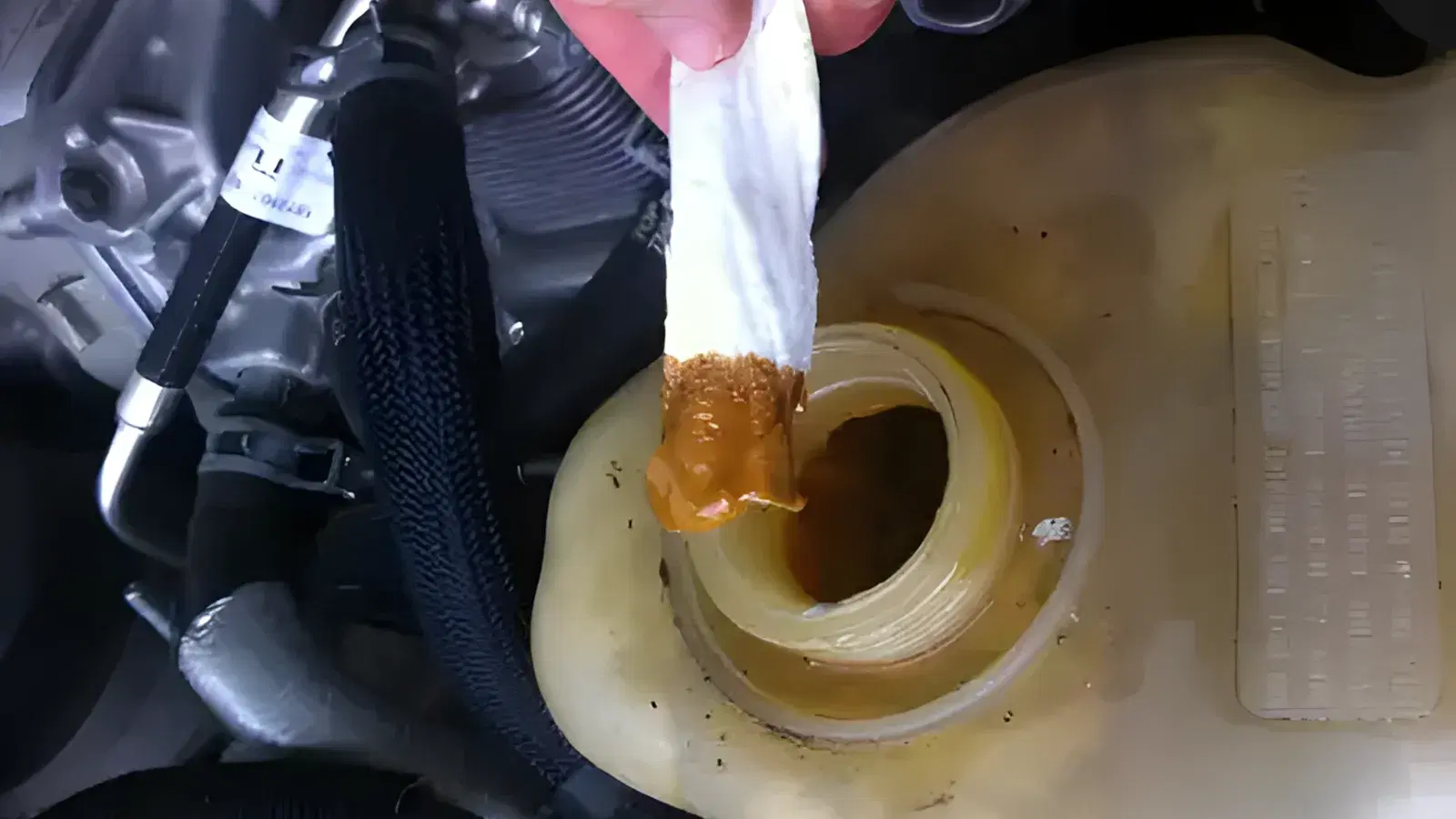
Brown sludge in the coolant tank means oil is getting into the cooling system, but it is not always the head gasket. A leaking engine oil cooler produces the same symptom and is usually a smaller repair. A cracked head or block is also possible. Only testing tells them apart, so do not guess or add stop leak.
At a glance
- Brown sludge in the expansion tank is oil in the coolant. Milky oil on the dipstick is coolant in the oil, and that one means stop driving.
- A leaking oil cooler, a failed head gasket and a cracked head or block can all mix oil and coolant, at very different repair costs.
- A creamy film under the oil cap alone, with clean oil and coolant, is often condensation from short trips.
- A combustion gas test on the coolant checks for a head gasket, cracked head or block without stripping the engine.
- Replacing the failed part is half the job. The contaminated system has to be flushed, refilled and bled.
You open the bonnet to check the coolant and something is wrong with it. Instead of clean, bright coolant, there is a brown sludge sitting in the expansion tank. Or you pull the oil cap and there is a milky film on the underside.
Search that symptom and the internet will tell you head gasket within about four seconds.
Sometimes it is. Often it is not. The difference between the possible causes is the difference between a manageable repair and a very large one, which makes this the worst fault on the list to guess at.
What does contamination actually mean?
It means oil and coolant have met. They run through the same engine in separate circuits that pass close to each other in several places. Anywhere those circuits are separated by a gasket, a seal or a cooler, there is a place they can meet if that separator fails.
Both directions mean something has failed. Neither should be topped up and ignored.
Which is worse: coolant in the oil or oil in the coolant?
Coolant in the oil. Coolant-contaminated oil stops lubricating the bearings properly, and the engine can be seriously damaged. Milky, mayonnaise coloured oil on the dipstick means stop driving.
The filter industry's technical bulletin on it is blunt. Coolant contaminated oil "does not provide the high lubricity required between close tolerance parts", and in the end "high temperature friction melts and welds the bearing surfaces to the journals." Machinery Lubrication adds that the resulting sludge can narrow oil passages, "causing partial or total starvation where the oil is intended to go."
Oil in the coolant shows up as brown sludge in the expansion tank. It is bad for the cooling system and it needs sorting, but in our experience it is generally less immediately destructive than the other direction.
Is a milky film under the oil cap always a problem?
No. A light, creamy film on the underside of the oil filler cap alone, with clean oil on the dipstick and clean coolant, is often just condensation. Short trips mean the engine never stays hot long enough to drive moisture out, so it condenses on the coolest metal it can find, which is the cap.
The Drive puts it simply: "If your trips are usually five to ten minutes long, chances are this is what's causing water to mix with your oil."
A Melbourne winter and a short commute produce this regularly. If the oil on the dipstick is clean and the coolant is clean, it is usually condensation rather than a failure. Take it for a decent run and see if it clears.
The test is what is on the dipstick and what is in the expansion tank, not what is on the cap.
What causes brown sludge in the coolant tank?
Most often a leaking engine oil cooler or a failed head gasket. Less often, a cracked cylinder head or block. On automatics with the transmission cooler inside the radiator, a cracked cooler mixes transmission fluid into the coolant instead. Four faults, one symptom, four very different bills.
This is why the page exists.
Oil cooler failure. Many engines, turbocharged ones especially, run an oil to coolant heat exchanger, and the cooler and the seals that mount it are places oil and coolant can cross. GMB, which makes cooling system parts, notes that "if the oil cooler leaks, the engine will still perform normally", which is exactly why it gets mistaken for a head gasket. It is usually a far smaller repair than a head gasket, and a good reason not to assume the worst.
Head gasket failure. The one everyone jumps to. It often comes with other company: white smoke from the exhaust, unexplained coolant loss, bubbles or pressure building in the cooling system, overheating or rough running. Often, not always. Professional Motor Mechanic notes that "a slightly blown head gasket does not display these obvious signs."
A cracked head or block. Less common, and often the aftermath of a serious overheat rather than something that happens on its own.
A leaking transmission cooler. Where the automatic transmission's cooler is built into the radiator, a crack between them lets transmission fluid into the coolant. GMB describes the result as "pink and foamy looking" rather than brown.
| Oil cooler | Head gasket | Cracked head or block | Transmission cooler | |
|---|---|---|---|---|
| What you tend to see | Oil in the coolant, engine runs normally | Oil or coolant contamination, often with white smoke, coolant loss or overheating | Similar to a head gasket, often after an overheat | Pink, foamy coolant on an automatic |
| What the combustion gas test shows | Nothing, as a rule | Combustion gases in the coolant | Combustion gases in the coolant | Nothing, as a rule |
| How we confirm it | Isolating and testing the cooler | Gas test, pressure test, then inspection | Gas test, pressure test, then inspection | Checking the radiator cooler |
| Relative size of the job | Usually the smallest | Large | Largest | Radiator or cooler replacement, plus the transmission if fluid has been contaminated |
Anyone who tells you which one it is over the phone is guessing.
What should I do if I find it?
It depends on what you find. Milky oil on the dipstick: stop driving and have it towed. Sludge in the coolant but clean oil: do not drive it far, and get it looked at this week rather than next month. Film on the cap only, everything else clean: take it for a longer run, then check again.
Overheating with any of the above: stop and shut it down.
And do not use a stop leak product. It is not designed for contamination, it makes the eventual diagnosis harder, and HELLA's workshop guidance warns that "the use of sealants may clog the heat exchanger in the same way as the radiator."
How do we find which fault it is?
By testing, not guessing. We look at everything first, then pressure test the cooling system, test the coolant for combustion gases, and isolate the oil cooler. Each step rules faults in or out, so the quote covers one repair, not a range covering all four.
Look at everything before touching anything. Oil condition, coolant condition, level history, service history and what the car has been doing.
Pressure test the cooling system. Whether it holds pressure, and how it loses it, narrows the field quickly.
Test for combustion gases in the coolant. A leak detector draws vapour from the cooling system through a test fluid that, in Professional Motor Mechanic's words, "is bright blue in colour, but in the presence of carbon dioxide (CO2) it turns yellow." A positive result points to the head gasket, or to a cracked head or block, and separates those cases from an oil cooler without pulling the engine apart.
Isolate the circuits. Testing the oil cooler separately tells us whether it is the crossover point.
Then quote. Once we know which fault it is, you get a price for that repair.
Why does the flush matter as much as the part?
Because the contamination has been circulating through the whole system, and if it is left in there you will be back. Replacing the failed component is only half the job. The contaminated circuits have to be cleaned out, refilled and proven before the car goes home.
HELLA's guidance is that a contaminated cooling system is drained and rinsed, the thermostat and the cap "should be replaced as a rule", and the expansion tank is replaced too if the contamination means its level can no longer be read. The system is then refilled following the vehicle manufacturer's instructions, bled and checked.
A proper repair means flushing the contaminated circuits thoroughly, replacing the oil and filter, refilling with the correct coolant, pressure testing, then running the engine to operating temperature and confirming it holds steady and stays clean.
Where coolant has been in the oil, we also want to know how far it went and for how long, because that affects whether the engine has been damaged already. It is better to have that conversation up front than after you have paid for the repair.
How can I catch it early?
Look in the expansion tank, not just at the level. Check the colour and clarity once a month with the engine cold, and pull the dipstick properly: wipe it, put it back, pull it again. Clean oil should look like oil.
And do not judge by the oil cap alone, for the reason above.
We diagnose it. We fix it.
If the coolant or the oil in your car does not look right, do not guess and do not drive on it. We will test it properly, and you get photographs and a written quote before any work is authorised.
We are in Dandenong, five minutes from the highway, with off street parking and early drop off. Book a diagnosis rather than a repair. The test is what tells you which of the four faults you actually have, and you can see which European marques we work on.
Sources
- Why is There Oil in the Coolant?GMB North America
- Blown head gaskets – how to detect themProfessional Motor Mechanic
- Technical Service Bulletin 89-1: Coolant Leaks into Engine OilFilter Manufacturers Community, Auto Care Association
- Rinsing and ventilating cooling systemHELLA TECH WORLD
- What Is the White Milky Substance Under Your Oil Cap?The Drive
- The Effects of Glycol Contamination in Engine OilsMachinery Lubrication
Common questions
- Is milky oil always a head gasket?
- No. A leaking oil cooler, a cracked head and a cracked block can all put coolant into the oil, and an oil cooler usually costs far less to fix than a head gasket. That is exactly why we test before we quote.
- Can I drive it if I keep topping the coolant up?
- Not if there is contamination. Topping up hides the symptom while the cause keeps getting worse, and if coolant is reaching the oil, every kilometre puts the bearings at risk.
- Will changing the oil or flushing the coolant fix it?
- Not on its own. A fresh oil change or a coolant flush removes the evidence for a while, but the part that is leaking is still leaking, and the contamination comes back. Flushing is the last step of the repair, not a substitute for it.
- Is it worth fixing on an older car?
- Sometimes yes, sometimes no. Once we know which fault it is, we will give you the number and an honest view, including if we think the car is not worth it.
Related reading
I Keep Topping Up the Coolant But There Is Nothing on the Driveway
Coolant going down every few weeks with nothing under the car. On VW Group 1.8 and 2.0 turbo petrol engines that is often a leaking water pump housing.
The Temp Gauge Climbs in Traffic But It Is Fine on the Freeway
A 2016 Mercedes-Benz C300 that ran warm at idle and normal at speed, with no puddle on the driveway. What a cracked thermostat housing looks like early.
White Smoke From the Exhaust: When It Is Nothing and When to Stop Driving
White exhaust smoke on a cold morning is condensation. Thick white smoke once the engine is warm usually means coolant, and that is a stop driving fault.
Want it looked at properly?
Factory-level diagnostics for eighteen European marques, and a written quote with photographs before anything is authorised.