

I Keep Topping Up the Coolant But There Is Nothing on the Driveway
Short answer
On VW, Audi and Skoda models with the 1.8 and 2.0 turbo petrol engines, coolant that keeps dropping with nothing under the car is commonly a slow leak from the plastic water pump and thermostat housing. The coolant lands on hot metal and evaporates, leaving a dried crust instead of a puddle. It needs a pressure test, not more top-ups.
At a glance
- A healthy cooling system is sealed. If you keep having to top it up, coolant is escaping somewhere.
- A slow seep onto a hot engine evaporates before it reaches the ground, so no puddle does not mean no leak.
- Look for dried pink or white crust around and below the housing, and notice a sweet smell after you park.
- If the temperature gauge climbs, stop driving. Running an engine hot can turn a housing repair into major engine damage.
- Top up only with the coolant your engine specifies. Mixing types or adding plain water reduces its protection.
That is how this one usually arrives at the counter. Coolant going down every few weeks, nothing ever appearing under the car, and the same conclusion every time: it drives fine, so it cannot be serious.
On VW, Audi and Skoda models running the 1.8 and 2.0 turbo petrol engines, that conclusion is usually wrong. This is one of the best documented faults in modern European cars, and it does not fix itself.
Why does the housing fail?
Because it is plastic, and it lives somewhere very hot. Every time the engine warms up and cools down, the housing expands and contracts. Over thousands of those heat cycles the material can warp, and cracks open at the seams and joints. Coolant then seeps out under pressure.
These engines use an integrated water pump and thermostat assembly, with an electronically controlled thermostat that manages engine temperature closely. It is a clever piece of engineering. It is also made from a composite plastic rather than metal. A US class action over these parts described a "thermoplastic water pump module" that "can crack".
Often the pump itself is still turning happily. The leak is at the housing, a seam or a seal. That matters when you compare quotes. Depending on the version and where it is leaking, the fix is either the whole pump and thermostat module, or just the thermostat housing. Volkswagen's own dealer guidance is to replace only the thermostat or its housing where that fixes the problem. So ask which part is being quoted, and why.
Why can't you see the leak?
Because it is usually a seep, not a pour. Coolant escapes onto hot metal and evaporates before it ever reaches the ground. As one European specialist workshop puts it, the seepage can "evaporate, leaving odor and residue instead of a visible drip." That dried pink or white crust is the clue worth looking for.
The assembly is also packed in tightly among pipework and under covers. There is a lot of engine between the crack and your line of sight.
Coolant also tracks. It runs along a pipe, dries somewhere else, and leaves a trail a long way from the actual crack. This is exactly why a visual inspection alone gets the wrong answer, and why we pressure test.
What should you watch for before the gauge moves?
A coolant level that keeps dropping, a sweet smell after you park, and dried crust around the engine. By the time the temperature gauge climbs, you are already in the expensive part of this story. The earlier signs are quieter.
- Coolant level dropping over weeks with nothing visible underneath
- A sweet smell hanging around after you park
- Dried pink or white residue around or below the housing
- A low coolant warning that appears, then clears, then appears again
- Steam or a hot smell from the engine bay after a run
- The heater blowing cooler than it should, or the temperature reading behaving oddly
- A check engine light, since the electronic thermostat can log faults of its own
The dash light is often the last thing to arrive, not the first.
Can you keep driving it?
For a few days, only if the loss is very slow and the engine is not running hot. Short local trips while keeping a close eye on the level is a reasonable risk.
If the temperature gauge is climbing, stop. Pull over, shut it down, and call us. A modern alloy engine that has been run hot can end up needing a head, or worse. Volkswagen's own US warranty extension for these parts covers engine damage caused by their failure, which tells you how far it can go. The repair you were avoiding will look very cheap in hindsight.
The reason we push people to act early is not sales pressure. It is that a cracked housing gives no warning before it opens up properly, and that usually happens on a hot day in traffic rather than in your driveway.
How we repair it
Scan it on ODIS first, the factory VW Group platform, because the electronic thermostat logs faults of its own and they tell us what the engine has been seeing.
Pressure test next. We put the cooling system under pressure and find where it is actually escaping. Guessing here is how people end up paying for two repairs. You get photographs of the failed part and a written quote before anything is authorised.
Replace what has failed, and say why. If the pump module itself is leaking, we replace the module rather than patch it. If only the thermostat housing is at fault and can be replaced on its own, that is what we quote. Either way you see the evidence first.
Correct coolant, correct fill. These engines are specific about coolant type. Volkswagen's own bulletin says some coolants can be mixed, but warns of "reduced corrosion protection when coolants are mixed", and a few combinations must not be mixed at all. Wrong coolant is a fault we regularly see created by well meaning top ups.
Bleed the system properly. Air trapped in the cooling system creates hot spots and a temperature reading that swings around. This step gets skipped more often than you would think and it is the reason some cars come back.
Check what else the heat has done. While access is good, we look at hoses, the expansion tank and the cap. And we look for evidence the engine has already been run hotter than it should, because that changes the conversation.
Recheck and road test. Pressure test again once it is together, then drive it and confirm the temperature holds steady.
How can you catch it early?
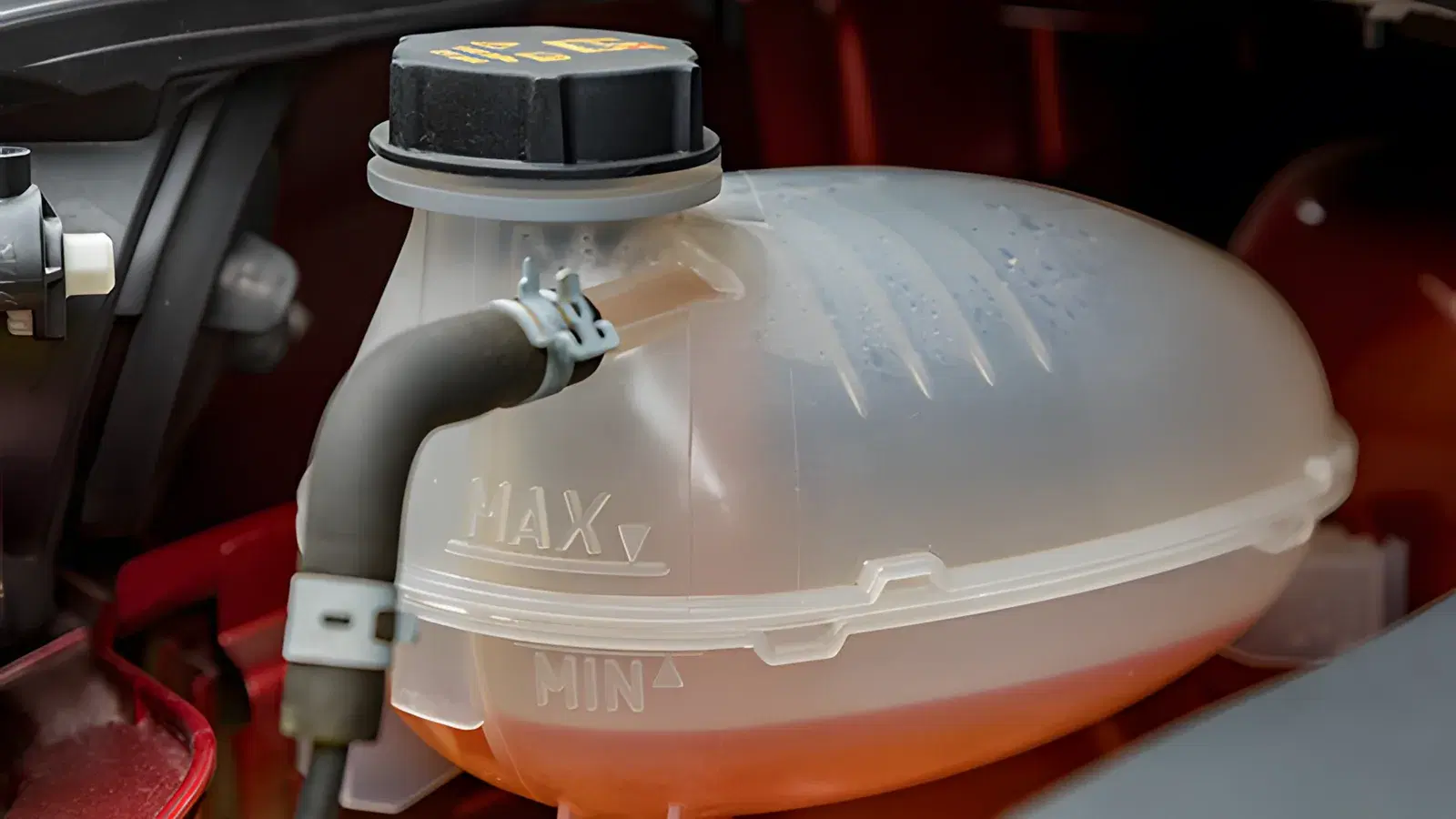
Check the expansion tank once a month with the engine dead cold, and note where the level sits. Same time of day, same conditions, so the readings compare.
The cooling system is sealed. Coolant is not burned off like fuel, so a healthy engine should not need regular top-ups between services. If yours does, it is leaking somewhere.
And look for dried residue rather than for puddles. Pale pink or white crust around and below the housing is the thing to find.
Is it just this car?
No. It runs right across the VW Group turbo petrol range, so Golf, Tiguan, Passat, Audi A3, A4 and Q5, and Skoda Octavia and Superb models with these engines can all have it.
Plastic cooling housings are not unique to Volkswagen either. We see similar leaks on other European turbo petrol engines, including the Mercedes M274 and BMW's four cylinder turbos, for much the same reason: a plastic part in a hot place, heat cycled thousands of times.
If you drive a modern European car and you are topping up coolant, this is the first thing worth ruling out.
Will an independent workshop void my warranty?
No. The ACCC found that manufacturer warranties on new cars, in most if not all cases, do not require servicing by an authorised dealer to keep the warranty. You can generally choose who services the car, "subject to the work being performed in accordance with the manufacturer's standards."
That is how we service: to the manufacturer's schedule, with approved fluids, recorded in your logbook. A warranty claim itself is different. Some manufacturers require warranty repairs to go through their own dealers.
We diagnose it. We fix it.
If your VW, Audi or Skoda is losing coolant and nobody has found where, we will pressure test it and show you the source.
We are in Dandenong, with off street parking and early drop off. Book it in, or see what our cooling system service covers.
Sources
- Water Pump Class Action and Limited Warranty Extension Dealer FAQVolkswagen of America (via NHTSA)
- 2015-2020 Volkswagen, Audi vehicle models suffer from water pump module defect, class action claimsClassAction.org
- Audi 2.0T (EA888) water pump and thermostat housing leak: early signs and fixMotronix
- Identifying and mixing Volkswagen engine coolants (TSB 19-17-01)Volkswagen of America (via NHTSA)
- Cooling systemsNulon
- New Car Retailing Industry market study: independent repairers' factsheetACCC
- Just bought a new car?ACCC
Common questions
- Will topping it up with water hurt anything?
- As a one-off to get you home, water is better than running low. Used repeatedly, it dilutes the coolant, lowering its boiling point and corrosion protection, and the system then needs draining and refilling with the correct coolant. If you have been adding water, tell us when you book.
- Could it be a head gasket instead of the housing?
- It can be. Coolant can also be lost inside the engine, through a failed head gasket or a cracked head, where it burns off in the cylinders. A pressure test, along with checking the oil and the exhaust, tells an internal leak from an external one before anything is quoted.
- Will the new part just fail again?
- These assemblies have been revised over the years, so the part fitted today is not always the same as the one that came out. We fit the current part for your engine and use the specified coolant, which gives the repair the best chance of lasting.
- My car is still under new car warranty. Where should I take it?
- Take it to the dealer first. Some manufacturer warranties require warranty repairs to go through their dealer network. If the car is out of warranty, or the dealer has quoted you and you want a second opinion, we are happy to look at it.
Related reading
The Temp Gauge Climbs in Traffic But It Is Fine on the Freeway
A 2016 Mercedes-Benz C300 that ran warm at idle and normal at speed, with no puddle on the driveway. What a cracked thermostat housing looks like early.
There Is Brown Sludge in My Coolant Tank
Search that symptom and the internet says head gasket in four seconds. Four faults produce it, at wildly different costs. Do not guess at this one.
White Smoke From the Exhaust: When It Is Nothing and When to Stop Driving
White exhaust smoke on a cold morning is condensation. Thick white smoke once the engine is warm usually means coolant, and that is a stop driving fault.
Want it looked at properly?
Factory-level diagnostics for eighteen European marques, and a written quote with photographs before anything is authorised.