

The Temp Gauge Climbs in Traffic But It Is Fine on the Freeway
Short answer
A temperature gauge that climbs in slow traffic but sits normal on the freeway usually means the cooling system has lost its margin. At speed, air forced through the radiator hides the problem. At idle the system relies on its fans, a full level of coolant and holding pressure. On this C300, a cracked thermostat housing was leaking.
At a glance
- A gauge that rises only in slow traffic is an early warning, not a quirk. Once the airflow from driving disappears, the system has nothing in reserve.
- No puddle does not mean no leak. A small weep onto a hot engine can evaporate before it ever reaches the ground.
- Modern cooling systems are sealed and should not need topping up. If the level keeps dropping, coolant is getting out somewhere.
- Plastic cooling parts go brittle with years of heat cycling. This C300's thermostat housing cracked at 142,000 km on a properly serviced car.
- Overheating can distort the cylinder head and damage the head gasket, a far bigger repair than the leak that caused it.
"The temp gauge climbs when I am stuck in traffic but it is fine on the freeway."
That is how the owner of this C300 described it when he rang. He also mentioned a sweet smell after parking, and that he had been topping the coolant up about once a month for six months.
There was never a puddle on the driveway. That is the part that had him convinced it could not be a leak.
The car was a 2016 Mercedes-Benz C300, W205 shape, running the M274 2.0 turbo four cylinder, with 142,000 km on it.
What the owner was seeing
No dash warning at all until right at the end. That is worth sitting with, because most people wait for the light.
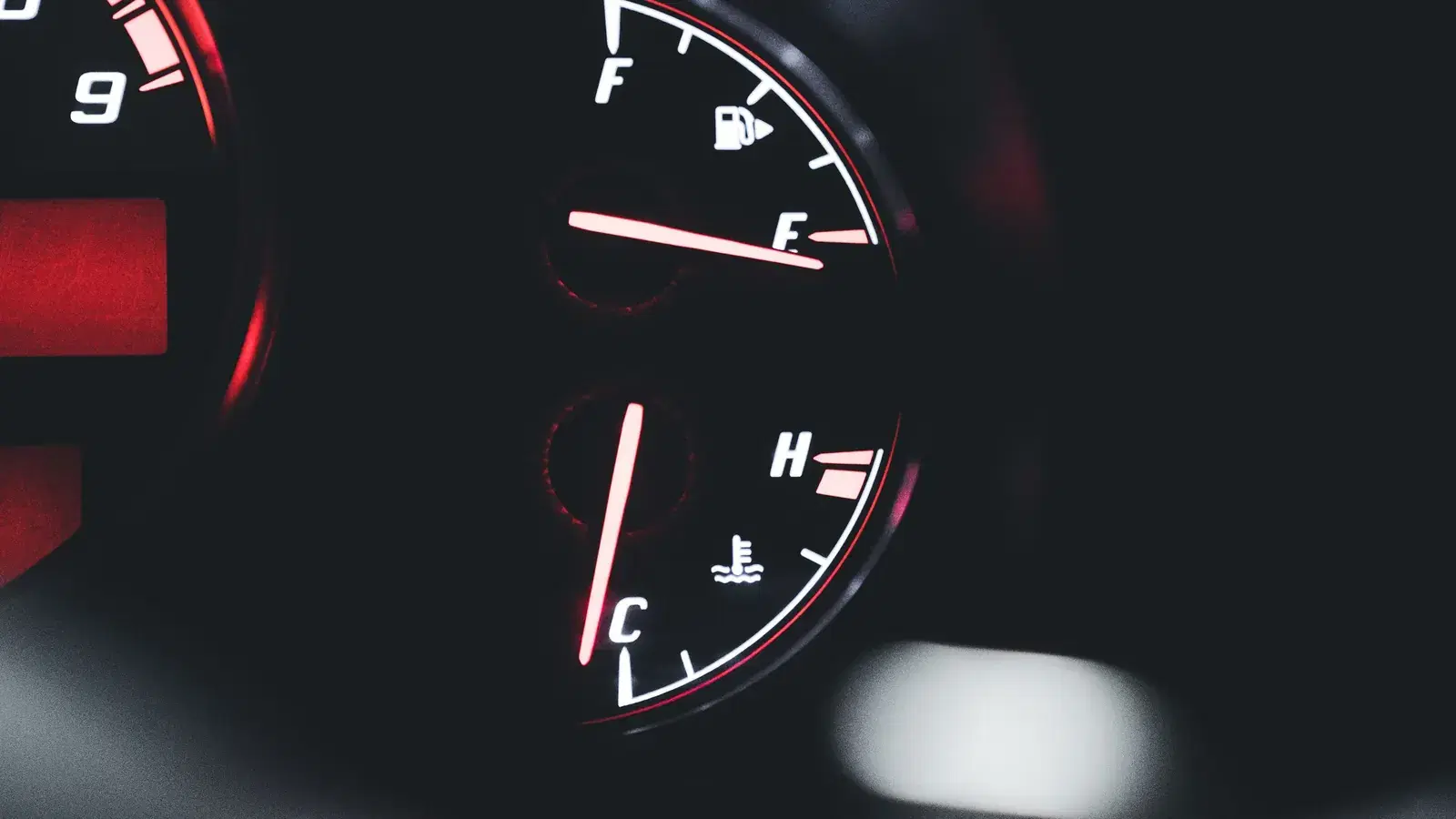
What he had instead was the needle sitting above normal only at idle or in slow traffic, and dropping back to normal the moment he got moving. A faint sweet smell after parking. And a coolant level that kept going down with nothing ever appearing underneath the car.
Six months of topping up, and no reason to think it was urgent.
Why was the freeway fine and traffic not?
Because at freeway speed, air forced through the radiator does most of the cooling. In stop and start traffic that airflow disappears, and the system depends on its fans, a full level of coolant and holding pressure. A system that is low on coolant and leaking pressure copes at speed and runs out of margin at idle.
This is the detail that makes the whole thing make sense, and it is why so many people misread it.
HELLA, which makes cooling system parts, puts the fan's job plainly: it supports cooling "in particular at slow speeds or during vehicle standstill." The NRMA says the same: the fan "provides air flow through the radiator when the car is not moving, such as when you're stuck in traffic."
Pressure matters too. HELLA notes the circuit runs at 1.0 to 1.5 bar, so the coolant "does not boil at a temperature of 100 °C, but only between 115°C and 130°C." A system that is leaking cannot hold that pressure, and loses some of that headroom.
So the car behaves perfectly on the drive that worries you least, and misbehaves crawling along at walking pace. Owners read that as the car being basically fine. It is the opposite. It is the system telling you it has no margin left.
Where was the coolant going?
Out of a cracked plastic thermostat housing, weeping at the seam, and straight onto a hot engine.
The coolant was evaporating before it ever reached the ground. That is the whole explanation for the missing puddle. There was no puddle because there was never enough liquid coolant in one place long enough to drip.
It also explains the smell. Engine coolant is treated ethylene glycol, which, as Bar's Leaks puts it, "smells sweet."
The expansion tank was also showing early stress crazing, the fine spider web cracking that appears in plastic that has been heat cycled for years. Not leaking yet. It would have been.
We confirmed the leak point with a cold pressure test before touching anything, because coolant tracks across an engine and the wet area is very often not the source.
Why did the housing crack?
Heat and time. The housing is plastic, and it sits on a hot engine. Every trip heats it and every night cools it, and over years of that the material goes brittle and cracks.
This car was at 142,000 km, and it had been serviced properly.
Which means this is not neglect. The owner had done nothing wrong. Plastic cooling parts age whether you look after the car or not. Worth saying plainly, because plenty of people assume a cooling fault means they missed something.
What we did
Full scan on XENTRY first, Mercedes-Benz's own diagnostic system, to see whether anything else had been stored while the car was running warm. Then a cold pressure test to confirm the leak point rather than guess at it.
The owner got photographs of the cracked housing and a written quote before we touched anything. That is how every job here is authorised.
Replaced the thermostat housing and the thermostat. Replaced the expansion tank and cap at the same time, since it was already crazing and the access was open. Doing it later means paying the labour twice.
Refilled with coolant to Mercedes specification, then vacuum filled and bled the system. That step matters more than it sounds. HELLA warns that "air in the cooling system considerably reduces the circulation of the coolant and may lead to engine overheating," which is how an otherwise correct repair can still come back.
Road tested to full operating temperature, including sitting in traffic deliberately, because a car that behaves on a test loop can still climb at idle.
About four hours.
What would another month have cost?
Potentially the engine. Another month of topping up and that housing lets go properly. Not a weep, a failure. And it happens under load in traffic, because that is where this car was already struggling.
Once an engine genuinely overheats, the damage moves past the leak. Victor Reinz, which makes head gaskets, lists "insufficient coolant or incorrect venting of the coolant system" among the classic causes of overheating, and notes that "component distortions can also be the result of engine overheating." A distorted cylinder head or a failed head gasket is a far bigger bill than a thermostat housing.
Six months of topping up was six months of warnings. The car was doing its job. The signal just did not look like a warning light.
How can you catch it early?
Check the expansion tank with the engine cold, and treat any drop in level as a leak. Both take a minute.
Check it once a month, engine dead cold. Not warm, not after a drive. Cold, first thing, before you start it. Note where the level sits.
And if you find yourself topping up, you have a leak. The AA says it plainly: "Most modern cars have a sealed cooling system so they shouldn't need topping up." Coolant is not consumed like fuel. Every millilitre that goes in is replacing something that got out, and it got out somewhere.
When you watch the gauge, watch it in stop and start traffic specifically, not on the freeway. The freeway is where this fault hides.
Is it just this car?
No. Plastic cooling parts on a hot engine are a weak point across many modern European cars, not only this Mercedes.
Volkswagen and Audi are the best-known example. A US class action alleged that the plastic water pump module on their 1.8 and 2.0 litre turbo petrol engines, which includes the thermostat, "can crack." Volkswagen settled, and extended the warranty on the water pump, thermostat and thermostat housing to eight years or 80,000 miles on the vehicles covered.
If you drive any modern European car and you are topping up coolant, a cracked plastic housing is one of the first things worth ruling out.
We diagnose it. We fix it.
If your temperature gauge climbs crawling along the Princes Highway but sits normal once you are moving, that is this fault until proven otherwise.
We will pressure test it and show you the leak. You get photographs and a written quote before any work is authorised, because the test is what tells us whether it is the housing alone or the housing plus what the heat has already done elsewhere.
We are in Dandenong, five minutes from the highway, with off street parking and early drop off. Book a cooling system inspection, or read what cooling system work covers.
Sources
- Engine cooling - design & functionHELLA Tech World
- Rinsing and ventilating cooling system - instructionsHELLA Tech World
- Why engine coolant is so importantNRMA
- How to check your engine coolant and top it upThe AA
- MLS cylinder-head gaskets and damage analysisVictor Reinz
- Smells that indicate car troubleBar's Leaks
- Water Pump Class Action and Limited Warranty Extension Dealer FAQVolkswagen of America (via NHTSA)
- 2015-2020 Volkswagen, Audi vehicle models suffer from water pump module defect, class action claimsClassAction.org
Common questions
- Is it safe to keep driving while I top up the coolant?
- Only as far as a workshop. A leak that is small today can fail under load, usually in traffic. If the gauge climbs, stop somewhere safe, switch off and call for help rather than pushing on. Stopping early is what saves the engine from expensive damage.
- Can I open the coolant cap to check the level while the engine is hot?
- No. The system runs under pressure, and the coolant inside can be well above 100 degrees without boiling. Opening the cap releases that pressure and can spray scalding coolant. Wait until the engine has fully cooled, ideally first thing in the morning.
- Could a faulty radiator fan cause the same symptom?
- Yes. The fan provides airflow through the radiator when the car is not moving, so a fan that is not running also shows up as a gauge that climbs only in traffic. The difference is that a fan fault does not use coolant. A pressure test and a scan tell the two apart.
- If I cannot find a leak outside, could it be the head gasket?
- It could. Coolant that disappears without any external sign may be leaking inside the engine. That is why we pressure test before replacing anything. It shows whether the coolant is escaping outside, as it was on this C300, or somewhere internal.
- What does a sweet smell after parking mean?
- Usually coolant. Engine coolant is based on ethylene glycol, which smells sweet, and a small leak onto a hot engine gives off that smell after you switch off. Treat it as a sign of a leak, even when nothing drips onto the driveway.
Related reading
I Keep Topping Up the Coolant But There Is Nothing on the Driveway
Coolant going down every few weeks with nothing under the car. On VW Group 1.8 and 2.0 turbo petrol engines that is often a leaking water pump housing.
There Is Brown Sludge in My Coolant Tank
Search that symptom and the internet says head gasket in four seconds. Four faults produce it, at wildly different costs. Do not guess at this one.
White Smoke From the Exhaust: When It Is Nothing and When to Stop Driving
White exhaust smoke on a cold morning is condensation. Thick white smoke once the engine is warm usually means coolant, and that is a stop driving fault.
Want it looked at properly?
Factory-level diagnostics for eighteen European marques, and a written quote with photographs before anything is authorised.